A Rainy Afternoon Collage from Paper Already at Hand
A rainy afternoon collage can turn clean paper scraps into a composed small work, using repeated shapes to make clear choices without extra supplies.
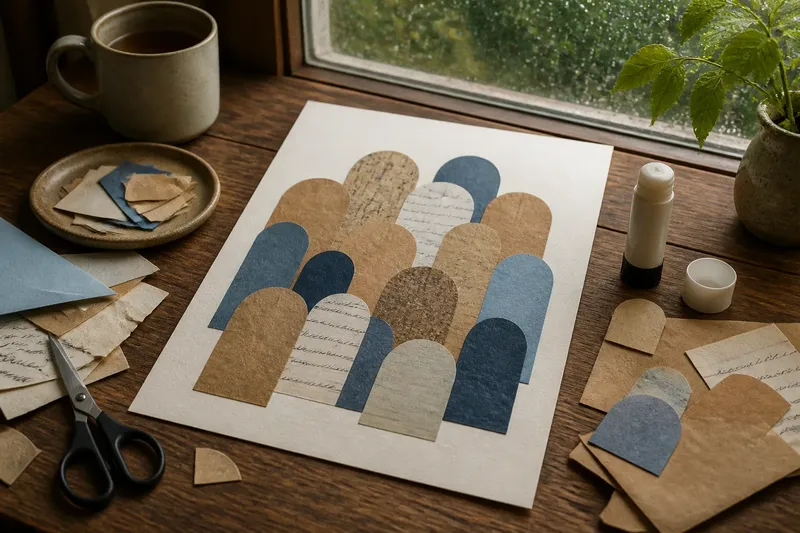
A rainy afternoon collage needs only clean paper, a surface to work on and one repeated shape to hold the pieces together. That constraint is useful when the weather keeps you indoors and your table already has envelopes, paper bags or unused sheets to hand: instead of hunting for special materials, you can decide what belongs in the composition by looking at what is available.
What kind of afternoon are you having?
Choose the approach that fits your energy and the paper in front of you. The aim is not to fill the whole afternoon or make an impressive object; it is to give a small collection of scraps a deliberate relationship.
- If you want a quiet, low-decision activity, choose one simple shape, such as a circle or arch, and repeat it. A single rule narrows the choices without making the result predictable.
- If your paper has strong colours or printed marks, choose a shape that can sit across those differences, such as a narrow strip or broad rectangle. The shape becomes a visual refrain while the source material supplies variation.
- If you have only a few scraps, make a compact arrangement with generous gaps. A small number of pieces can feel intentional when their spacing is considered.
- If you have a mixed pile of paper, sort it by colour or surface first, then select one repeated shape. This gives the eye a common feature to follow through a varied set.
Clean paper can include the blank backs of envelopes, uncoated packaging, old drawings you are happy to reuse, or sheets with a little printed text. Avoid anything damp, greasy or heavily coated if it is difficult to cut or place; there is no need to rescue a scrap that makes the session awkward.
Which repeated shape will carry the collage?
Pick a form you can recognise quickly and make more than once without measuring. Circles, triangles, arches, leaves and blunt-ended strips all work. A repeated shape does not have to be identical each time: hand-cut circles may vary, and that slight difference can keep the surface lively.
Decide what “repeat” means before cutting. You might use the same outline in several paper types, or repeat one colour in different sizes. Keep one feature constant and let the others change. If every piece differs in shape, colour, size and direction, the eye has little to return to; if nothing changes, the arrangement may feel rigid.
Say you have a brown paper bag, a blue envelope and a page with a few lines of handwriting. You decide on arch shapes, cut several from the bag and envelope, then add one or two from the handwritten page. The repeated outline links the papers, while the visible writing gives a few arches a different weight; you can judge the balance by moving them around before fixing anything down.
How should you arrange paper before sticking it down?
Start with a backing sheet that can lie flat. Place the largest pieces first, then add smaller repeats, leaving some of the backing visible. Try a loose row, a cluster or a gradual drift from one edge towards the middle; these are simple arrangements, not templates you have to follow.
Pause when the eye has a clear route through the shapes. If all the pieces sit at equal distances, shift a few closer together. If one colour dominates, let a smaller piece of that colour reappear elsewhere to connect the composition. Turn the paper as you work; a layout that feels crowded in one orientation may open up when rotated.
For an especially calm session, use the back of an envelope as a temporary palette. Lay out the cut shapes there, grouping them by colour or texture, and transfer them to the backing only when their order feels settled. This makes rearranging easy and prevents glue from becoming part of the decision-making too soon.
What should you use to attach the pieces?
For ordinary thin paper, a glue stick is usually the least fussy option. Apply it sparingly across the back, pay attention to corners and edges, then press the piece onto the backing with a clean scrap of paper between your hand and the adhesive if needed. A suitable paper glue can also work; follow its label and the maker’s directions, since products and surfaces differ.
If you have no adhesive, leave the arrangement loose and treat it as a temporary composition. You can photograph it for your own reference, or simply enjoy the arrangement before returning the scraps to the pile. Tape is not automatically a better substitute: visible tape may distract, and some papers can tear when it is removed.
It is not worth spending the afternoon trying to make every edge perfectly smooth or searching the house for decorative extras. The repeated form is already doing the organising. A small irregularity often helps show that the collage was made by hand.
What if the paper or mood is different?
Can I use paper with writing on it?
Yes, if the writing is clean and you are comfortable reusing it. Let the marks show through the repeated shapes in a few places, or turn the paper so that the text becomes texture rather than a message.
What if I cannot cut matching shapes?
Make the outlines approximately alike and keep another feature consistent, such as colour or direction. Repetition is a visual relationship, not a demand for machine-perfect copies.
How many shapes should I make?
Make a small first batch, arrange it, then cut more only if the composition needs them. This keeps the paper pile manageable and lets the backing sheet’s empty spaces remain part of the design.
Can I make the collage without glue?
Yes. A loose layout can be the finished activity, especially if you want to change it later or do not have a suitable adhesive. Keep the pieces together in an envelope if you would like to revisit the arrangement.
When is the collage ready to stop?
Stop when the repeated shape is easy to spot, the papers have some room around them and no single adjustment seems clearly necessary. You do not need to use every scrap. Leaving a few pieces aside is a useful way to preserve the composition’s breathing space rather than treating leftover paper as a problem.
A rainy afternoon collage can stay modest: one backing sheet, a handful of clean scraps and a shape that returns often enough to give the work coherence. If you want to continue later, keep the remaining paper and note which shape you used; that small record makes it easy to begin again without turning a relaxed making session into a larger project.