Graphite or Ink for a One-Page Sketch?
Graphite or ink for a one-page sketch? Compare their line character and reversibility to choose a tool that suits your subject and the attention you want.
Graphite or ink for a one-page sketch? Choose graphite when you want to revise a shape as it develops; choose ink when you want each mark to stay visible and make the next one answer it. For a single-page study, the tool is not just a way to record what you see: it changes what you notice while drawing.
What does graphite let you change?
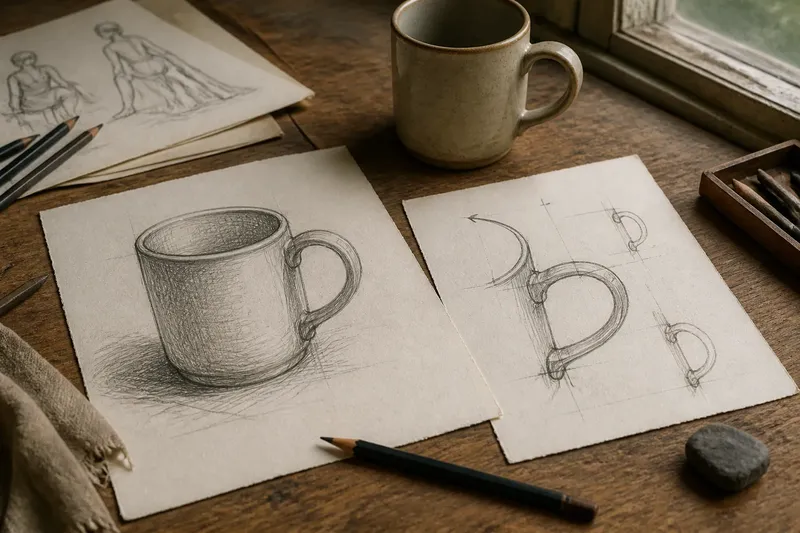
Graphite sits on the paper surface, so a light line can often be softened or lifted with a kneaded eraser. That makes it useful for subjects whose proportions are still uncertain: a bent plant stem, an unfamiliar mug, or a hand whose angles are hard to read at first glance.
A wooden pencil gives a narrow point when freshly sharpened and a broader mark as the tip wears down. A mechanical pencil keeps a consistent point, while a softer graphite grade lays down darker tones with less pressure. The trade-off is that a soft, heavy mark can smudge and may not lift cleanly.
Think of erasing as editing rather than a route to a spotless page. If you remove every tentative line as soon as it seems wrong, you may lose useful evidence of how a form turns. Keep a faint guide where it helps, then make the clearer contour darker.
How does ink change the line?
Ink makes a more definite record. A fineliner tends to give a steady, even stroke; a dip pen or brush can vary in width with the movement and pressure of the hand. The mark remains in the drawing, so a misplaced line cannot simply be rubbed away.
That permanence can encourage attention to edges, overlaps and the order of marks. You might decide which contour matters most before touching the nib to the page, then use shorter strokes to describe a complicated turn. The page can feel less like a place to search and more like a sequence of choices.
Ink is not automatically more confident or expressive. A hesitant line can still look hesitant, and repeated tracing may make a contour muddy. Let a line do one job at a time: describe an edge, indicate a shadow, or connect one form to another.
Which tool suits the subject?
For a soft or changing subject, graphite can make gradual transitions without forcing every boundary into a fixed outline. It also suits a study in which you want to compare several possible silhouettes. For a subject with clear overlaps or a distinctive outer edge, ink can help separate the main forms from small details.
Paper matters too. Smooth paper lets a fine nib travel with little interruption, while toothier paper can catch a pencil and produce a grainier tone. A brush pen may behave differently on absorbent paper than on a surface intended for drawing, so check the product label and manufacturer’s guidance if you are unsure about compatibility.
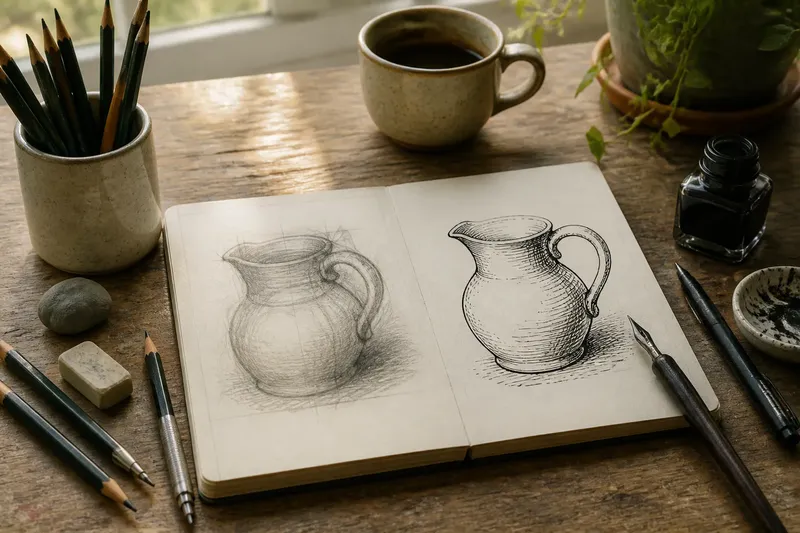
Say you are sketching a small ceramic jug on a kitchen table and cannot yet tell how its handle joins the body. Begin with pale graphite, adjusting the oval and handle until the connection reads clearly; then leave the useful construction lines faint and strengthen the outer contour. The expected visible result is a jug whose proportions remain easy to read without erasing every trace of the search.
What do you want to notice while drawing?
Graphite draws attention to degrees: how much darker one plane is, how far a curve changes, or where a shadow fades. Ink draws attention to decisions about separation and emphasis: which edge continues, which disappears behind another form, and where a line should stop.
Neither tool prevents you from noticing the other qualities. You can make a tonal ink study with closely spaced hatching, or use graphite chiefly for contours. Still, a one-page exercise often benefits from a constraint. Pick the quality you most want to observe, then choose the medium that makes that quality easiest to keep in view.
Graphite or ink for a one-page sketch: what should you ask?
Can I combine graphite and ink on one page?
Yes, if you decide what each medium contributes. A light graphite guide beneath ink can help with placement, while graphite added around ink can supply softer shading; check that the paper and any ink you use are suitable for layering.
Will an eraser remove every graphite mark?
No. Pressure, paper texture and the grade of graphite affect how readily a line lifts. A kneaded eraser can lighten a mark gently, but rubbing hard may roughen the paper or leave a trace.
Is ink a poor choice for a beginner?
No; it simply offers less opportunity to revise a line after it is made. A broad, uncomplicated subject can make a useful study in choosing a few clear marks rather than trying to control every detail.
What if I cannot decide before I begin?
Make a small mark near the edge of the page with each tool, then choose the one whose line fits the study you have in mind. If uncertainty itself is the subject, keep the first few graphite lines or use ink to record each attempt without correcting it.
What is not worth the effort?
There is little value in hunting for a perfect pencil grade or pen before making a simple study. A familiar HB pencil or a pen that flows reliably is enough to discover whether you want adjustable tone or a settled line. Spend the attention on the subject, not on making the tool choice feel irreversible.
For a one-page sketch, graphite offers room to adjust and ink makes the path of each decision visible. The phrase “graphite or ink for a one-page sketch” becomes easier to answer when you name the observation you want to make: changing form, tonal shift, clear overlap or deliberate contour. Once you know that, choose the tool that helps you keep looking.