Before the Sketchbook: How Artists Kept Working Drawings
Explore working drawings before the sketchbook: learn how loose sheets supported planning, sharing and arranging studies without relying on a bound book.
Working drawings before the sketchbook were often made on separate sheets, which an artist could arrange beside a design, hand to a collaborator or keep apart from other work. Their value lay not in being incomplete, but in serving a particular task: recording a form, planning an arrangement or communicating an idea.
What was a working drawing for?
A working drawing is made to help with a task in the making of art. It might study the tilt of a head, record how folds cross a sleeve or plan where figures could sit in a larger composition. Its purpose is practical, even when the marks are expressive.
A finished picture, by contrast, is generally shaped to stand as a complete work for a viewer. This distinction is not about skill or tidiness. A careful drawing may be preparatory, while a loose, energetic drawing may be intended as the finished piece. Purpose and context matter more than surface polish.
Some working drawings focus on observation; others combine remembered forms with a proposed arrangement. A drawing might also communicate with another person, such as a workshop assistant who needs to understand a pattern or a painter planning a scene.
Why use separate sheets instead of a book?
A bound book keeps pages in sequence. Separate sheets can be moved around: an artist can place one beside a larger design, group related studies, show a page to a colleague or keep a delicate drawing apart from other materials. These practical differences help explain why loose sheets and books can serve different purposes.
Surviving drawings come from particular places and periods, so no single account describes every artist’s materials or habits. Sheets of paper are one familiar format, but drawings also survive on prepared supports and other surfaces. The support affects how a mark sits and how a drawing can be handled; by itself, it does not tell us whether the work was a study or a finished picture.
Separate sheets also make it possible to organise a group by subject or task rather than by the order in which observations were made. That feature matters when considering historical practice: a loose drawing’s place in a larger project may be difficult to recover if its original companions or notes are missing.
How can you tell a study from a finished picture?
Working drawings often leave some parts unresolved. A hand may appear as a few directional strokes because its gesture matters more than its anatomy; a building’s proportions may be clear while its surface details are absent. This selectivity can point to the question the artist was addressing.
Finished pictures tend to organise attention for a viewer, with edges, tones and details arranged to make the image feel complete or guide the eye. A study may instead focus on one issue, such as whether a shoulder angle fits a pose. It need not settle every visual decision.
When reading a drawing, avoid judging it only by how complete it looks. Ask what problem it might address, which marks carry the most information and what remains open. Repeated contours, changes in scale or directional marks can offer clues, but they do not prove the artist’s intention.
What questions help you understand a working drawing?
Does an unfinished drawing always prepare for another work?
No. A drawing may be intentionally spare, or it may have been left unfinished for reasons that cannot be seen. Look for a focused task, such as comparing outlines or studying one feature, before describing it as preparatory.
Can a study stand as an artwork in its own right?
Yes. A drawing made during planning can also hold interest as an independent work. Its function in a project and its value to a viewer are related, but they are not the same question.
Why might an artist make several studies of one subject?
Separate drawings can record different viewpoints, gestures or arrangements. Keeping them apart allows each to be considered on its own, though their original order or relationship may not always be known.
What can a drawing’s surface tell you?
The surface can help explain how the artist made and handled the drawing, but it cannot establish the work’s purpose by itself. Consider the marks, subject and surviving context together, and keep uncertainty where the evidence is limited.
How can you make a useful study on a loose sheet?
Choose a clear visual question before you begin: the angle of a chair back, the outline of a pear or the folds at an elbow. Use ordinary drawing paper and a pencil, and let the sheet focus on that question rather than trying to become a complete picture.
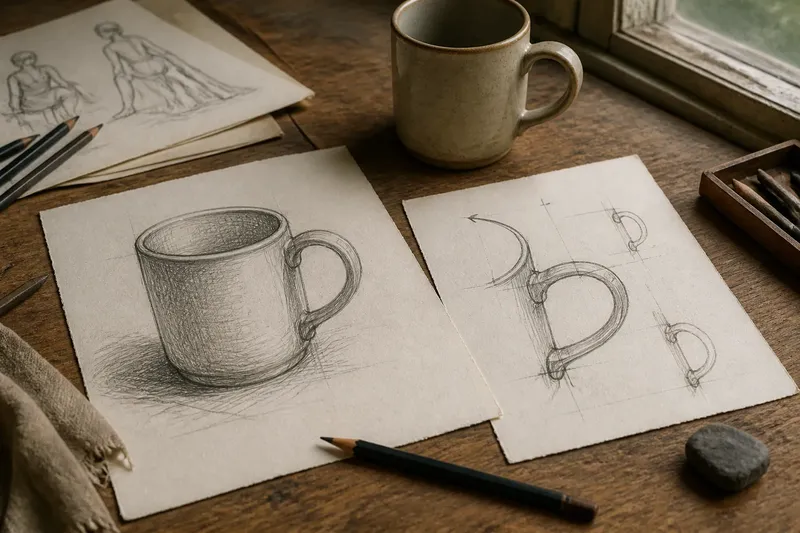
Say you want to understand a ceramic mug beside a window. Start with a sheet of paper and a pencil; draw the mug’s outer contour in broad strokes, then mark the rim and handle. On a second sheet, draw only the relationship between the handle and rim. Compare the pages: the first should make the overall silhouette easier to judge, while the second should make the parts’ positions clearer. If neither answers the question, change your viewing angle and make a new study rather than adding a decorative background.
- Check whether the sheet has a clear subject; if it does, keep the study focused on that subject, but if it does not, choose one object or feature before drawing.
- Check whether the question is about outline; if it is, use broad contour marks, but if it concerns a small relationship, isolate the relevant parts instead.
- Check whether the drawing needs to be compared with another; if it does, make a separate sheet for the alternative, but if it does not, keep the study on one sheet.
- Check whether a short note would explain the viewpoint or purpose; if it would, add a few words such as “view from chair”, but if the context is already clear, leave the sheet unlabelled.
- Check whether the sheets belong to the same subject or question; if they do, keep them together in a folder, but if they do not, file them separately.
- Check whether a border or full background helps answer the drawing question; if it does, add only the useful detail, but if it does not, leave it out and keep attention on the study.
Elaborate titles and borders are usually not worth the effort when they do not clarify what the sheet records. A brief note can help when the viewpoint or purpose might otherwise be forgotten; decoration cannot substitute for that context.
What did the sketchbook add to working drawings?
A bound sketchbook gathers observations into a portable sequence. Its pages might record a route through a place, variations on a pose or objects seen at different moments. Turning between pages can make comparison easier, while the order may preserve something about how the artist encountered a subject.
Loose sheets remain useful for different reasons. They can be positioned beside a larger work, passed to another person or sorted with related designs. The choice between a book and separate sheets depends on whether sequence, rearrangement or sharing matters most.
Working drawings before the sketchbook show that an artist could use a separate sheet as a focused record or a practical part of a larger project. When choosing a format for your own study, decide whether you need an ordered sequence or a page you can move and compare; that small choice can make the drawing easier to use later.